diaton &tm;
companynewsorder informationcontactscontacts
Description
Operational manual
Articles
Tests
Advice of Experienced User
Training Video (avi)
Certificates and approvals
DIATON tonometer

What's ahead in 2007
Decking the halls with new products from 2006

by Maxine Lipner EyeWorld Senior Contributing Editor

Transpalpebral Diaton tonometer

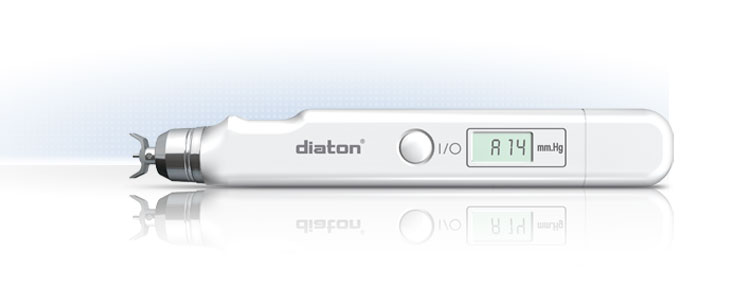
One product potentially on the ophthalmic wish list is a unique new ocular pressure measuring device that received Food and Drug Administration (FDA) approval this year. The pen-like device, dubbed the transpalpebral Diaton tonometer (BiCom, Long Beach, New York) measures intraocular pressure (IOP) through the eyelid and requires no direct contact with the cornea, as other methods have previously necessitated.

Henry D. Perry, M.D., clinical professor of ophthalmology, Cornell Weill School of Medicine, New York, said the device, which is used with the patient's eyes closed, is much less anxiety-provoking for people. "Patients often have a fear of anything coming toward their eyes," he said. "With their eyes closed there is less guarding and fewer false readings as when somebody squeezes their eyelids."

The transpalpebral tonometer works by pressing it to the closed eye and depressing a plunger that gently hits the lid. "By the amount of pressure exerted on the plunger when striking the eyelid and slightly indenting the globe, it can judge the IOP within 2 to 4 mmHG, when compared with the Goldman applanation tonometer (Haag Streit, Mason, Ohio), which is the standard of care," Dr. Perry said.

He said he did a study where he evaluated 100 consecutive patients and found a 95% correlation with the Goldman tonometer, proving its accuracy. However, there is a bit of a learning curve for some technicians. Dr. Perry said there was one technician in his practice whose results were always precise, while others had outcomes that varied.

Dr. Perry said the new handheld tonometer, has a good fit for screenings in large clinics, where technicians or optometrists may be in charge. "I think in settings like that it may be easier to use," Dr. Perry said. It may also be better for children.


EyeWorld Magazine
February 2-5, 2007

Ryazan State Instrument-making Enterprise &tm;