diaton &tm;
companynewsorder informationcontactscontacts
Description
Operational manual
Articles
Tests
Advice of Experienced User
Training Video (avi)
Certificates and approvals
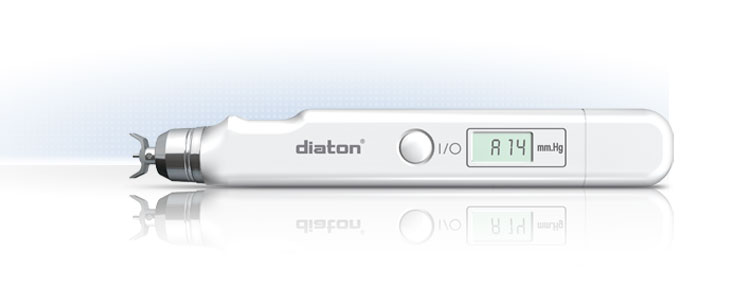
DIATON tonometer

Test report and a comparison of the pressure measurements
of the digital portable tonometer DIATON for the measurement of the intraocular pressure through the eyelid

Ina Conrad-Hegegerer MD., Mr. Fritz Hengerer MD.
Eichenstrasse 3, 65468 Trebur, Germany

The measurements have been conducted in Germany, in our private doctor's office by Mrs. Ina Conrad-Hegegerer MD. and Mr. Fritz Hengerer MD.

The results have been obtained with the following methods:

  1. Applanation tonometry by Goldmann(Splitlamp Haag Streit 900)
  2. Digital portable Tonometer Diaton
  3. Non-Contact tonometry with Niedek Tonometer 1000

The purpose of the measurements is to evaluate the reliability of Diaton in the direct comparison with the already established processes.


There were 2 groups of test persons: Healthy subjects and glaucoma patients. Exclusion criteria were: Previous glaucoma patients, eyelid operations or inflammatory states of the front eye section. Furthermore, patients were excluded where a Goldmann tonometry could not be performed (Keratokonus, Epitheledema).


The static analysis contains:

a) Mean
b) Standard deviation
c) Median error
d) Correlation coefficient (Pearson)

Table 1. shows the measurements on healthy patients, Table 2. on those with glaucoma.


The results of the statistical analysis are summarized in Table 3. and 4.


Summary:
The analysis of the measurements confirms the validity of the measurements of the digital portable Tonometer Diaton.

The researcher is able to perform the measurements of the eye pressure on the sitting, as well as on the lying patient. The procedure is exceptionally suitable for patients with allergies, as anesthesia is not required. Furthermore measurements can be conducted on patients with a Blepharospasm (a lid spasm that occurs when the eyelid is touched) or in cases of cornea trauma, where non-contact-tonometry or applanation tonometry (Goldmann) are mostly impossible.

The clinical everyday life has shown that an easy sterilization of the portable tonometer as well as the low weight is of a great advantage and they also allow IOP-measurements at home visits by the doctor or councils.

Overall the measurements via the eyelid have been found by more then 90% of the tested as more comfortable in direct comparison to the other 2 processes, as well as the short measurement time of <3 seconds.


The researcher has to take great care of the correct device placement behind the ciliary edge of the upper eyelid and has to assure that the measurement is performed while looking down, while performing measurements with the portable digital tonometer.


The measurements are not meaningful if performed incorrectly and they may leave an increased eye pressure condition undetected.


I would like to add that IOP-Measurements with the digital portable tonometer DIATON, in a direct comparison with its predecessor TGDc-01 "PRA" are performed even easier, while having a significantly better usability and self-verification. The DIATON tonometer has proven itself very good as well in the clinical all-day life in our doctors office as at home visits. It allows the examiner to perform in a lot of other fields without being dependent on additional "hardware".


There are further studies being conducted to enable special clinical operation fields in surgery such as Refractive surgery, cataract surgery, vitreoretinal surgery (silicon oils) etc.

Table 1. Healthy patients.

¹ Name, year of birth Eye Goldmann Diaton Nidek
1Hahn, 1936OD
OS
15
11
13
11
14
13
2Johanson, 1956OD
OS
14
14
15
15
20
16
3Bredel, 1940OD
OS
10
12
11
13
14
14
4Mehring, 1972OD
OS
7
8
9
7
9
11
5Eberwein, 1968OD
OS
20
17
19
17
23
20
6Peters, 1926OD
OS
18
19
20
18
19
21
7Muller, 1934OD
OS
17
16
16
15
16
16
8Weber, 1962OD
OS
18
18
19
17
18
19
9Lachmann, 1949OD
OS
14
12
12
10
15
13
10Bamberger, 1928OD
OS
15
13
13
11
14
14
11Schonemann, 1942OD
OS
15
13
14
15
22
17
12Strobel, 1951OD
OS
12
10
11
10
11
11
13Faller, 1965OD
OS
19
18
18
20
20
20
14Schneider, 1958OD
OS
18
18
19
17
18
18
15Eisele, 1946OD
OS
12
13
15
16
13
13
16Diekmanns, 1932OD
OS
17
18
15
17
17
21
17Weinreuter, 1952OD
OS
16
14
14
15
21
19
18Weifbacher, 1933OD
OS
14
12
15
12
15
13
19Hoffmann, 1943OD
OS
17
16
16
15
16
16

Table 2. Glaucoma patients

¹ Name, year of birth Eye Goldmann Diaton Nidek
1Rahn, 1927OD
OS
22
18
22
19
23
21
2Dahlberg, 1944OD
OS
12
48
14
45
15
48
3Bach, 1936OD
OS
27
23
27
23
24
22
4Bornhold, 1963OD
OS
17
14
17
14
10
16
5Scmidt, 1928OD
OS
16
32
16
32
16
35
6Solbach, 1952OD
OS
12
19
12
19
12
18
7Richter, 1931OD
OS
15
12
15
12
9
7
8Friebel, 1925OD
OS
14
15
14
15
14
15
9Kreutzer, 1960OD
OS
23
27
23
27
24
22
10Baumges, 1937OD
OS
20
10
20
10
22
12
11Dilfer, 1942OD
OS
21
15
21
15
21
16
12Ibert, 1939OD
OS
32
15
32
15
34
15
13Schohl, 1943OD
OS
16
14
16
14
15
14
14Wagner, 1929OD
OS
35
15
35
15
33
16
15Roth, 1938OD
OS
14
15
14
15
16
21

Table 3. Glaucoma patients

TonometryM +/-, m, mm Hg? +/- M?, mm Hg
Goldmann19,66 +/- 1,498,19 +/- 1,06
Diaton19,60 +/- 1,447,86 +/- 1,02
Correlation coefficient r=0,94 +/- 0,01

Table 4. Healthy patients

TonometryM +/-, m, mm Hg? +/- M?, mm Hg
Goldmann14,74 +/- 0,513,15 +/- 0,36
Diaton14,61 +/- 0,513,14 +/- 0,36
Correlation coefficient r=0,94 +/- 0,02
Ryazan State Instrument-making Enterprise &tm;